AI voice agents are rapidly reshaping how call centers operate. Transforming call centers with AI, these intelligent systems help reduce long wait times, prevent customer frustration, and assist staff by delivering faster, smarter, and more reliable service at scale. AI in call centers matters for business growth, allowing companies to improve customer experiences while increasing efficiency and streamlining operations.
Modern AI voice agent call center rely on cloud-based call center technology and scalable computer systems for customer support, providing the ability to manage high call volumes securely and efficiently. By connecting with smart IoT devices for real-time customer data, businesses can track user behavior, optimize responses, and create more personalized interactions.
Beyond improving service, AI voice agents enhance digital marketing strategies using artificial intelligence, allowing companies to automate campaigns, measure customer engagement, and offer personalized marketing promotions. They also support financial services using AI automation, helping detect unusual transactions, provide instant account support, and improve overall decision-making, all while running on high-tech technology infrastructure for business operations.
By combining AI-powered customer support systems, cloud-based communication networks, and intelligent marketing tools, companies can create a seamless ecosystem where customer service, marketing, and finance work together to drive better results. AI voice agents not only respond to inquiries—they also gather insights, support business intelligence, and enhance experiences across multiple online channels.
This guide explores what AI voice agents are, how they work, and how they can turn your call center into a high-performing, always-on customer experience hub, while integrating cloud technology for call centers, AI-driven marketing solutions, intelligent financial tools powered by AI, and modern technology infrastructure for business growth to deliver smarter results.
Top 10 AI Voice Agent Call Center Solutions
In today’s fast-evolving customer service landscape, AI voice agent call center solutions are transforming how businesses handle customer interactions. From automating routine inquiries to providing intelligent support, these platforms help call centers deliver faster, smarter, and more personalized experiences. Here’s a curated list of the top AI voice agent call center solutions, starting with the leading platform.
1. Bright Pattern – AI Contact Center Solutions
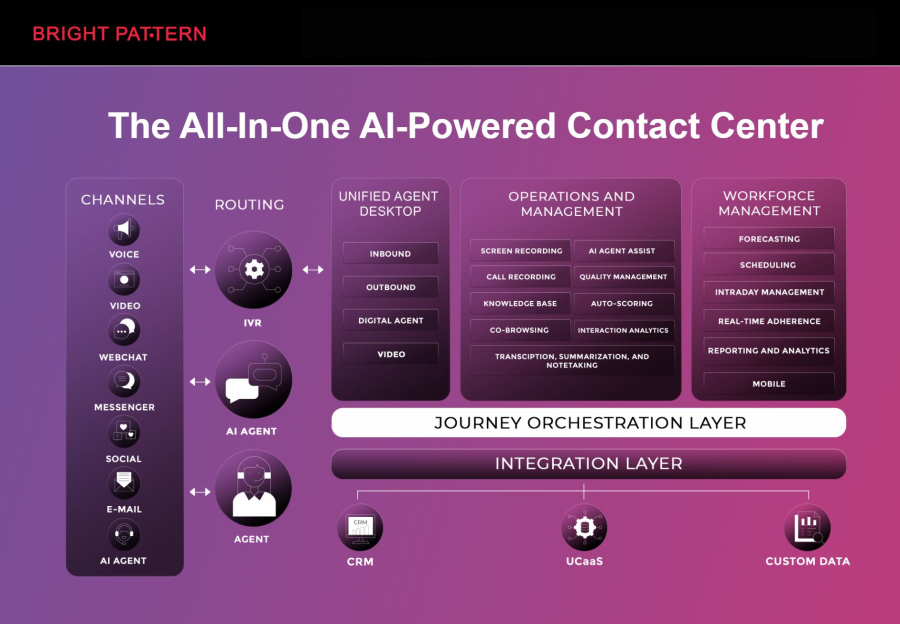
Bright Pattern is a cloud-based AI voice agent call center solution designed for businesses of all sizes. It combines advanced AI technology with an intuitive interface to streamline customer service and improve agent efficiency. Bright Pattern enables seamless communication across multiple channels, including voice, chat, SMS, and social media.
Key features include:
- Omnichannel routing to ensure every customer reaches the right agent quickly
- AI-powered virtual assistants that handle routine inquiries and free human agents for complex cases
- Real-time analytics and reporting for performance monitoring and continuous improvement
- Easy integration with CRM systems, cloud infrastructure, and marketing automation tools
- Scalability to support growing business needs without compromising service quality
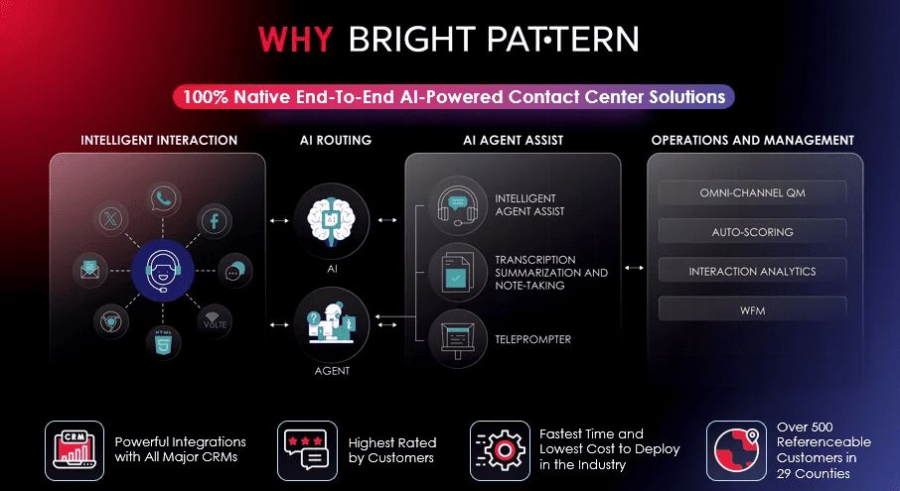
Bright Pattern’s AI contact center solutions help businesses reduce wait times, enhance customer satisfaction, and improve operational efficiency, making it a top choice for modern call centers.
2. Genesys Cloud CX
Genesys Cloud CX offers AI-driven contact center solutions designed to enhance customer engagement across voice, chat, and email. Its platform supports intelligent routing, virtual agents, and real-time analytics.
3. Five9 Intelligent Cloud Contact Center
Five9 provides AI voice agent call center software with automated workflows, predictive dialing, and AI-assisted agent tools. It’s widely used for customer service, sales, and technical support operations.
4. Talkdesk CX Cloud
Talkdesk delivers AI-powered call center solutions with smart routing, machine learning analytics, and integration with major CRM platforms, helping businesses optimize customer interactions.
5. NICE inContact CXone
NICE inContact CXone combines AI virtual agents with workforce optimization tools to improve agent productivity and customer satisfaction. It supports omnichannel engagement for a seamless experience.
6. Avaya OneCloud CCaaS
Avaya’s AI-enabled contact center platform offers advanced speech analytics, automation, and cloud-based communication solutions that enhance both agent performance and customer experience.
7. RingCentral Contact Center
RingCentral provides AI-driven call center solutions that integrate voice, chat, and digital channels, allowing businesses to manage customer interactions efficiently while leveraging AI insights.
8. Cisco Webex Contact Center
Cisco’s AI-powered contact center platform supports omnichannel engagement, intelligent call routing, and real-time reporting, helping organizations improve service quality and operational efficiency.
9. 8x8 Contact Center
8x8 offers AI voice agent call center solutions with automated interactions, CRM integrations, and analytics to streamline workflows and improve customer satisfaction.
10. Amazon Connect
Amazon Connect is a cloud-based AI call center platform that uses machine learning to provide personalized, intelligent customer interactions and real-time agent assistance.
What Is an AI Voice Agent in a Call Center?
AnAI voice agentis an automated system that can understand spoken language, respond with natural speech, and handle common call center tasks without a human agent. Unlike traditional IVR (press 1, press 2 menus), AI voice agents use advanced technologies such as speech recognition and natural language understanding to hold conversational, back‑and‑forth interactions.
In a call center, AI voice agents can:
- Greet callers and identify why they are calling.
- Authenticate customers securely.
- Provide answers to frequently asked questions.
- Process routine requests (like balance checks, order status, or appointment booking).
- Route complex issues to the right human agent with full context.
The result is a more human‑like, frictionless experience that lets customers speak naturally instead of navigating rigid menus.
How AI Voice Agents Work (Without the Jargon)
Behind every smooth AI voice interaction is a set of coordinated technologies. At a high level, a call center AI voice agent usually follows this flow:
- Speech recognition (ASR)– Converts the caller's spoken words into text.
- Natural language understanding (NLU)– Analyzes the text to figure out intent (what the caller wants) and key details (names, dates, numbers, etc.).
- Decisioning or dialog management– Chooses the next best step: answer a question, ask for more details, perform an action, or transfer to a human agent.
- Back‑end integrations– Securely connects to your CRM, ticketing system, billing platform, or other tools to look up data or complete tasks.
- Text‑to‑speech (TTS)– Turns the AI's response into natural sounding speech in the caller's language.
This cycle repeats in milliseconds, enabling a fluid conversation that feels increasingly similar to speaking with a live agent.
Key Benefits of AI Voice Agents for Call Centers
Implemented thoughtfully, AI voice agents deliver value on multiple levels: customer experience, operations, and business performance.
1. Elevated Customer Experience
- 24/7 availability– Provide live, consistent support outside of business hours without hiring overnight teams. Customers can get help at any time, from any time zone.
- Shorter wait times– AI voice agents handle a large volume of routine queries in parallel, dramatically reducing queues for human agents.
- Always‑on consistency– Every caller gets the same accurate, compliant, and on‑brand response, regardless of time of day or agent experience.
- Natural conversations– Modern AI understands open‑ended questions and everyday phrasing instead of forcing callers through rigid menu trees.
- Faster resolutions– By identifying intent quickly and accessing data in real time, AI agents often resolve simple issues in a single interaction.
2. Leaner, More Efficient Operations
- Scalable call handling– During spikes in call volume, AI voice agents can absorb a large share of demand without additional seats or overtime.
- Lower cost per contact– Automating high‑frequency, low‑complexity interactions frees human agents to focus on higher‑value conversations and reduces overall handling costs.
- Smarter routing– When escalation is needed, AI can capture context (caller identity, reason for call, previous steps) and pass it all to the human agent, reducing repeat questioning and handling time.
- Operational resilience– AI voice agents are not affected by absenteeism, seasonality, or unexpected surges, making your operation more predictable.
3. Happier, Higher‑Performing Human Agents
- Less repetitive work– AI takes over routine, repetitive calls, allowing human agents to handle more meaningful, complex issues that require empathy and judgment.
- Reduced burnout– Fewer back‑to‑back basic calls and better tools lead to lower stress and higher job satisfaction.
- Real‑time assistance– In augmented modes, AI can listen to live calls and suggest responses or knowledge articles, helping agents ramp up faster.
- Better performance insights– Automated call summaries and tagging provide clearer feedback and coaching opportunities.
4. Stronger Business Outcomes
- Improved customer satisfaction (CSAT)– Faster, more accurate service tends to lift satisfaction scores and reduce complaints about wait times.
- Higher first call resolution (FCR)– When customers reach the right resource with the right context the first time, resolution rates improve.
- Actionable insights– AI can aggregate and analyze call reasons, sentiment, and trends, feeding valuable intelligence back into product, marketing, and operations.
- Future‑ready infrastructure– Investing in AI voice today lays a foundation for omnichannel automation across chat, messaging, and self‑service portals.
Top Use Cases for AI Voice Agents in Call Centers
AI voice agents work best when they are focused on clear, repeatable processes. Below are some high‑impact use cases that many call centers implement first.
1. Intelligent Front Door and Call Triage
Instead of "Press 1 for sales, 2 for support," AI voice agents can start with an open question like: "How can I help you today?" They then:
- Understand the caller's intent in their own words.
- Verify identity if needed.
- Route to the appropriate queue or handle the request directly.
- Pass a concise summary to the human agent when escalating.
This reduces misrouting, transfers, and the frustration of repeating information.
2. Self‑Service for Common Requests
Many call center interactions follow predictable patterns. AI voice agents can fully resolve frequent requests such as:
- Checking account balances or order status.
- Resetting passwords or unlocking accounts (with secure verification).
- Updating contact details or preferences.
- Scheduling, confirming, or canceling appointments.
- Providing policy information, FAQs, or step‑by‑step instructions.
These are high‑volume, low‑complexity tasks where automation delivers major time and cost savings.
3. Proactive Outbound Notifications
AI voice agents can initiate outbound calls to keep customers informed and reduce inbound traffic. Examples include:
- Appointment reminders with an option to reschedule via voice.
- Payment reminders or due‑date notifications.
- Service outage alerts with real‑time updates.
- Order or delivery status confirmations.
By addressing needs before customers feel the need to call, you increase satisfaction and protect your agents from spikes in volume.
4. Intelligent Callbacks and Queue Management
Instead of making customers wait on hold, AI voice agents can:
- Offer a callback when wait times are high.
- Capture and confirm the best callback number and time.
- Verify customer details and reason for calling in advance.
When the callback occurs, the human agent starts with context in hand, reducing handling time and improving the experience.
5. Post‑Call Surveys and Feedback
After a human agent interaction, an AI voice agent can seamlessly gather feedback, asking:
- How satisfied the customer was with the support received.
- Whether their issue was resolved.
- Open‑ended feedback in the customer's own words.
AI then analyzes the voice feedback to detect sentiment, themes, and recurring pain points, giving leadership clearer visibility into experience quality.
AI Voice Agent vs. Traditional IVR: What's the Difference?
Many organizations ask whether AI voice agents simply replace their existing IVR. In practice, AI usually enhances or modernizes it. Here is a simplified comparison.
|
Capability |
Traditional IVR |
AI Voice Agent |
|
Interaction style |
Menu‑driven ("press 1, press 2") |
Conversational, open‑ended questions |
|
Understanding of natural language |
Very limited |
Understands a wide range of phrasing and intents |
|
Personalization |
Basic; same path for most callers |
Dynamic flows based on profile, history, and context |
|
Complex task handling |
Challenging to design and maintain |
Can orchestrate multi‑step workflows and data lookups |
|
Maintenance effort |
High when menus change often |
Configurable conversational flows; easier to expand |
While IVR focuses on routing, AI voice agents focus on resolving. The most successful call centers often use both: AI to understand and handle requests, with IVR‑style fallbacks for edge cases or compliance‑critical paths.
Designing a High‑Performing AI Voice Agent Experience
AI is powerful, but results depend heavily on design. Below are proven practices for building an AI voice experience that customers will love.
1. Start With the Right Use Cases
Instead of trying to automate everything at once, choose a narrow set of high‑value, low‑risk journeys such as:
- Order status checks.
- Appointment confirmations.
- Simple billing questions.
- Basic account inquiries.
Measure the impact, learn from customer behavior, and expand steadily into more complex interactions.
2. Map the End‑to‑End Customer Journey
Before building, clearly map how the call should flow:
- Entry points (inbound call, callback, transfer from another line).
- Required authentication steps.
- Decision points (what if the customer says X, Y, or Z?).
- Success outcomes and completion criteria.
- Fallback paths (when to transfer to a human, when to repeat, when to offer a different channel).
This ensures conversations feel coherent and purposeful rather than disjointed.
3. Design for Clarity and Transparency
Customers respond better when they know what they are dealing with. Effective experiences typically:
- Open with a clear introduction that the caller is speaking with an AI assistant.
- Explain what the system can help with in simple, friendly language.
- Provide reassurance that a human agent is available if needed.
Being transparent builds trust and sets realistic expectations.
4. Give Customers Control
Even the best AI will not handle every scenario perfectly. Build in graceful ways for customers to change course, such as:
- Recognizing phrases like "agent", "human", or "representative" as escalation triggers.
- Offering options like "Would you like to speak with an agent?" when the system is uncertain.
- Allowing callers to repeat or rephrase without restarting from the beginning.
Empowering customers this way turns potential frustration into a good experience, even when automation is not the final solution.
5. Continuously Learn and Improve
AI voice agents are not a "set and forget" tool. The most successful programs:
- Monitor call transcripts and common failure points.
- Regularly refine intents, training data, and conversation flows.
- Test new prompts, wording, and routing strategies.
- Collect direct feedback from agents on where the AI helps or struggles.
This continuous optimization cycle steadily improves containment rates and customer satisfaction.
Implementation Roadmap: How to Bring AI Voice Into Your Call Center
A structured implementation plan helps you minimize risk and maximize early wins. While every organization is different, a typical roadmap includes these phases.
Phase 1: Strategy and Alignment
- Define success metrics such as call containment rate, average handle time (AHT), CSAT, or cost per contact.
- Prioritize use cases based on call volume, complexity, and business impact.
- Engage stakeholders from operations, IT, compliance, and customer experience early.
- Decide whether the AI voice agent will augment human agents, fully automate some flows, or both.
Phase 2: Technical Foundation
- Integrate the AI platform with your telephony system or contact center platform.
- Connect to core systems such as CRM, ticketing, billing, and knowledge bases.
- Establish authentication methods (PIN, one‑time codes, or other secure options).
- Set up logging, monitoring, and analytics for all AI‑handled calls.
Phase 3: Conversation Design and Training
- Draft scripts, prompts, and responses that reflect your brand voice.
- Define intents and entities based on real call transcripts and historical data.
- Train the AI with diverse phrasing, accents, and edge cases.
- Run internal tests with employees to uncover confusing phrases or gaps.
Phase 4: Pilot and Controlled Rollout
- Launch the AI voice agent for a subset of callers (for example, specific call reasons or hours).
- Closely track containment rates, transfer rates, handle time, and customer feedback.
- Host regular review sessions with supervisors and front‑line agents.
- Iterate quickly to fix issues and fine‑tune flows.
Phase 5: Scale and Optimize
- Gradually expand coverage to more call types and segments.
- Introduce advanced features like sentiment awareness, real‑time coaching, or outbound campaigns.
- Continuously refresh content and knowledge sources as products and policies evolve.
- Benchmark performance against your original metrics and update targets as the AI matures.
Success Metrics: How to Measure Impact
Clear metrics keep your AI voice initiative grounded in business value. Common KPIs include:
- Call containment rate– The percentage of calls fully handled by the AI without human intervention.
- Average handle time (AHT)– For calls that involve both AI and humans, how long do they take compared to human‑only calls?
- Transfer and escalation rate– How often does the AI transfer to a human agent, and at what points?
- Customer satisfaction (CSAT or NPS)– Are customers happier, neutral, or less satisfied with the AI experience versus traditional support?
- First call resolution (FCR)– Are more issues being resolved in a single interaction?
- Cost per contact– How does the cost of AI‑assisted or AI‑handled calls compare to fully human‑handled calls?
Pairing quantitative metrics with qualitative feedback (call transcripts, surveys, agent comments) gives you a complete picture of impact.
Risk Management, Compliance, and Customer Trust
While AI voice agents bring major advantages, responsible deployment is essential, especially in regulated industries. Consider these safeguards:
- Data privacy– Ensure call recordings, transcripts, and customer data are stored and processed in line with relevant regulations and internal policies.
- Clear disclosures– Inform callers when calls are recorded and when they are interacting with AI rather than a human.
- Secure authentication– Use robust verification before sharing sensitive information or performing high‑risk actions.
- Escalation paths– For complex, emotional, or high‑risk scenarios, make it easy for customers to reach a trained human agent quickly.
- Bias and fairness– Periodically review AI performance across accents, languages, and demographics to detect and correct any imbalances.
With these measures in place, AI can enhance customer trust by delivering dependable, secure, and transparent service.
Future Trends: Where AI Voice in Call Centers Is Heading
AI voice agents are evolving rapidly. Several trends are shaping the next generation of call center experiences:
- More human‑like conversations– Advances in speech synthesis and large language models are making AI voices more natural, expressive, and context‑aware.
- Omnichannel orchestration– AI systems will increasingly remember context across channels, so a conversation started on chat can continue seamlessly over voice and vice versa.
- Real‑time guidance for human agents– Instead of just handling calls independently, AI will act as a real‑time coach, suggesting responses, next best actions, and upsell opportunities.
- Hyper‑personalization– With appropriate safeguards, AI will tailor each interaction based on customer history, preferences, and behavior patterns.
- Deeper analytics and forecasting– AI will not only answer calls but also predict demand, identify new service opportunities, and highlight process improvements.
Organizations that start building AI capabilities today will be better positioned to take advantage of these innovations as they mature.
Frequently Asked Questions About AI Voice Agents in Call Centers
Will AI voice agents replace human call center agents?
AI voice agents are best viewed aspartnersrather than replacements. They excel at handling repetitive, clearly defined tasks at scale. Human agents remain essential for:
- Complex problem solving.
- Emotionally sensitive situations.
- Negotiations and nuanced decision‑making.
- Building long‑term relationships with high‑value customers.
Most organizations see the best results when AI and humans work together, each focusing on what they do best.
How long does it take to see value from an AI voice agent?
Timelines vary with scope, but many call centers see early benefits within weeks of a focused pilot. Quick wins usually come from automating one or two high‑volume call types, then expanding to additional use cases as data and confidence grow.
Do AI voice agents work in multiple languages and accents?
Modern AI speech technologies support a wide range of languages and accents. Performance does depend on training data and configuration, so it's important to test with real customer speech samples and continuously tune the system for your audience.
What kind of internal resources are needed?
Successful programs typically involve collaboration between:
- Contact center operations leaders.
- IT or telephony teams.
- Conversation designers or business analysts.
- Compliance and security stakeholders.
- Supervisors and experienced agents who understand real call dynamics.
Many organizations start small, then build dedicated teams as AI becomes a core part of their service strategy.
Bringing It All Together
AI voice agents give call centers a powerful way to deliver faster, more reliable, and more scalable service without sacrificing the human touch. By automating routine interactions, guiding customers through intuitive conversations, and empowering human agents with better context and tools, AI turns every call into an opportunity to impress.
Whether your goal is reducing wait times, lifting CSAT, supporting growth without adding headcount, or giving your team more meaningful work, AI voice agents can be a cornerstone of that transformation when planned and implemented thoughtfully.
The organizations that move early, learn quickly, and keep humans at the center of their design will be the ones that set the new standard for call center excellence
